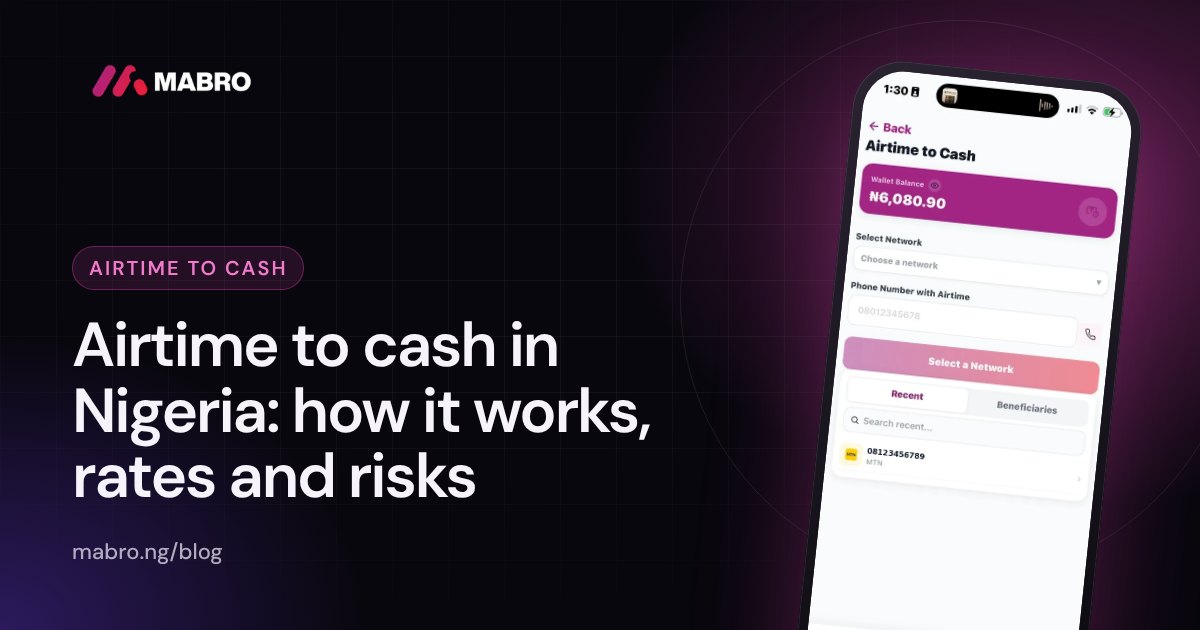
Airtime-to-cash (A2C) converts a balance sitting on your SIM into naira in your wallet or bank. It is popular because many people top up airtime more often than they top up a bank balance, and because airtime is easy to move between numbers.
But the process has more moving parts than it looks: carrier rules, transfer limits, a PIN that must never leave your hands, and a discount that decides what you actually receive. This guide covers all of it.
How the transfer works
Your airtime does not leave the telecom network as cash. There are two practical ways to move it:
- USSD transfer — your network’s own airtime-transfer menu moves airtime from your line to the receiving line. Networks usually charge a small fee and set a daily limit.
- Share/ME2U transfer via app — the same idea through the carrier’s interface, using your transfer PIN.
The receiving side (the provider) confirms the airtime arrived, then pays the equivalent amount, minus a discount, into your wallet or bank.
The key detail is that the airtime leaves your line first. Until the receiving line confirms, the balance is in transit, and the network — not the platform — controls that leg.
What the rate means
A2C is usually quoted as a percentage of the face value. A 90% rate on ₦5,000 pays ₦4,500. The difference covers the network transfer fee, the receiving line’s own operations, and fraud risk.
Rates are shown before you confirm — check the naira figure, not just the percentage. A “90%” on a small amount can be worth less than an “85%” with a lower network fee on a larger one.
Limits you should know
Every carrier limits how much airtime one line can transfer per day, and some require the line to have been active long enough. Glo, for example, restricts the number of transfers a line can make per day. If a platform promises unlimited same-day transfers, it is promising something the network will not allow.
Limits also change. Treat any number you hear in a group chat as a rumour and check the current rules in the app or on the network’s own menu.
Why the transfer sometimes fails
- Daily limit reached. The line has already transferred its maximum for the day.
- Wrong PIN. The transfer PIN is separate from your app login; it is set on the SIM.
- Insufficient airtime. Bonus airtime is often not transferable, even when it shows in the balance.
- Network mismatch. The receiving line must belong to the same network as the sender.
- Inactive line. A new or dormant line may not qualify for transfer.
The risk nobody warns about
The biggest danger is not the rate — it is the counterparty. Airtime sent to a fake “agent” is gone; there is no chargeback. People are also asked to reveal their transfer PIN, which allows the holder to empty future balances from the line.
A real A2C flow never asks for your network PIN over chat. The PIN is entered by you, in your own app, on your own line. If someone needs your PIN to “process” the transfer, they are processing your line, not your trade.
Step by step with Mabro
- Open Sell Airtime in the app and choose the network.
- Enter the phone number holding the airtime and the amount. The app shows the naira you will receive.
- Confirm, then complete the airtime transfer using your network’s USSD prompt or the in-app flow, with your own transfer PIN.
- The receiving line confirms receipt and the naira lands in your Mabro wallet, usually within minutes.
- Withdraw to your bank, or spend it in the app.
How long it takes, realistically
The airtime leg is usually immediate once the carrier processes it. Confirmation on the receiving side is typically minutes. The wallet credit follows confirmation. Bank withdrawal then follows normal payout timing — quick during banking hours, slower at night or on weekends.
If the transfer is still pending after a few minutes, check the transaction detail before repeating it. Duplicate transfers can hit the carrier’s daily limit and leave you with less airtime than you planned.
When A2C makes sense — and when it does not
It makes sense when you have airtime you will not use: a bonus, a mistaken top-up, a SIM whose balance keeps growing. It makes less sense as a habit for moving large sums: the discount plus network fees makes it more expensive than a direct bank transfer.
Compare the final amount with what you would pay to fund your wallet another way. If the discount plus fees exceed that, A2C is the more expensive route and the convenience is the only thing you are buying.
Keeping your line safe
- Never share your transfer PIN, SIM swap code, or OTP.
- Set a PIN you do not use anywhere else.
- Do transfers yourself, in your own app.
- If your SIM suddenly loses network, treat it as a SIM-swap attempt and call the carrier immediately.
- Check your balance after every transfer — you should see the exact amount leave.
Business lines and volume
If you resell airtime or run a shop, understand the carrier’s rules for high volume before you build a process around them. Limits that are generous for one person can be restrictive for a daily business, and repeated attempts after a limit is hit can look like abuse to the network.
Why airtime-to-cash exists at all
Airtime is the most funded balance in Nigeria. People top up for calls and data, receive airtime as a bonus, or find themselves with more balance than they need. Turning that value back into naira solves a real problem: airtime you will not use is otherwise stuck.
The flip side is that the process moves value through carrier systems that were designed for airtime, not for cash. That is why the fees, the limits and the odd failure modes exist.
How the carrier side really works
Each network runs its own transfer system. Airtime moves from your line to the receiving line, and the network charges a fee for the transfer. The recipient then has airtime on their line — which is why an A2C platform has to convert it into naira for you.
Because the airtime lands on a receiving line first, two things follow. First, the receiving line’s limits matter as much as yours. Second, the platform’s confirmation is the moment the value is recognised; until then, the trade is incomplete.
Setting up your transfer PIN
The transfer PIN is set on the SIM, not in the app. If you have never set one, the network’s USSD menu will walk you through it. Choose six digits you do not use anywhere else, and never share them — a shared PIN is a shared line.
If you have forgotten the PIN, use the network’s own reset flow. Do not accept a “helper” who offers to reset it for you over chat; that is the start of a SIM-swap scam.
Do the arithmetic before you sell
Take the face value, apply the rate, then subtract the network transfer fee. If a ₦5,000 sale at 90% pays ₦4,500, that is the figure to compare — not the 90% headline. A lower percentage with a lower fee can pay more on small amounts.
Also compare against simply spending the airtime. If you use ₦5,000 of airtime in calls and data within the month, converting it at a discount destroys value. A2C is for balance you will not use.
The receiving line and why the network checks it
Networks impose transfer limits per line, per day, to reduce abuse and fraud. A receiving line that has taken many transfers in a day may hit its limit even when your own line is fine. Platforms that work at scale spread receipts across lines, which is why a transfer can occasionally be slower than usual.
Fraud patterns specific to A2C
- “Send the airtime first, I’ll pay after.” The airtime is not reversible.
- PIN harvesting. Anyone asking for your transfer PIN is taking your line, not your trade.
- Fake platforms. A page that collects your number and PIN and then disappears. Check that the flow happens inside a real app.
- The “overpayment” trick. A “buyer” sends too much and asks you to refund the difference before the transfer fails.
When selling for a business
Retailers and airtime agents often hold large balances. Before building A2C into a daily routine, confirm the carrier’s rules for high volumes, and keep a record of every sale: date, amount, rate, receiving line and payout. If a dispute arises, the record is your only defence, and it also tells you which network is cheapest for your volume.
After the sale
Funds land in your Mabro wallet. From there you can withdraw to your bank or spend in the app. Withdrawal timing follows normal banking hours; the wallet credit itself is immediate once the transfer is confirmed.
Network differences that matter
Each carrier runs its own transfer product with its own fee, daily cap and eligibility rules. Some lines must be active for a minimum period; some bonus balances are excluded; some networks charge more for transfers than others. Because these change without notice, any specific number you read is a snapshot — the rule that survives is simple: the transferable balance and the carrier’s window are what count.
Practically, this is why A2C platforms ask you to choose the network explicitly. The same amount on different networks can produce different fees and different success rates on the same day.
What to do if airtime goes to the wrong number
There is no automatic reversal. Call the number, explain, and ask the recipient to transfer it back. If they refuse, the carrier may record the transfer but cannot force a return. This is exactly why confirming the number before pressing the PIN matters — the app cannot undo a completed transfer.
Why bonus airtime behaves differently
Promotional and bonus balances often cannot be transferred. You may see ₦3,000 in balance and still be unable to transfer more than the eligible portion. The app shows the amount it expects to receive; if the transfer fails for insufficient transferable balance, the bonus is the usual reason.
After the transfer: confirmation and credit
The receiving line confirms receipt, then the platform credits your wallet. If you do not see the credit, check the transaction detail before assuming failure. A transfer that left your line but is not yet confirmed is pending, not lost; resubmitting during that window can double-send and hit the daily limit.
Volume, limits and business use
Daily limits apply per line, and they reset on the carrier’s schedule — not yours. A retailer who sells twice the limit in a day will hit the cap regardless of how much balance is on the line. Plan volume around the limit, or split across permitted lines, but never attempt to work around a carrier’s controls; repeated attempts look like abuse and can trigger a block.
Security habits that matter most
- Never share the transfer PIN, even with someone claiming to be support.
- Do the transfer yourself, in your own app.
- Watch for SIM-swap signs: sudden loss of service, unexpected “welcome” messages, a carrier call asking you to confirm details.
- Check the balance after every transfer.
When the rate looks too good
A2C rates hover in a narrow band because carrier fees are near-fixed. A quote far above the market usually means the payout will be delayed, reduced by hidden charges, or never made. Compare the final naira figure and the payment method, not the percentage.
What a trustworthy A2C flow shows you
Before you commit, a good flow shows the network, the receiving number, the face value, the rate, the naira you will receive, and the carrier fee if any. It tells you the transfer must be made from the line holding the airtime and asks you to confirm both numbers. It never asks for your PIN in a text field outside the carrier’s own prompt.
If a flow is vague about any of those, stop. The details are not decoration; they are the difference between a trade you can verify and one you have to trust.
Four questions to ask before choosing a platform
Where does the payout go? It must be your own verified wallet or bank account. A platform paying someone else is not solving your problem.
What is the receiving number, and is it shown before you transfer? You should send airtime to a number the platform displayed, not one a chat contact gave you.
What does the fee breakdown look like? Rate, carrier fee, payout fee — all visible before confirmation.
What happens when a transfer fails? A clear answer, not “contact support” with no reference. Ask this before you need it.
The words that matter
Face value — the naira amount of airtime you are selling.
Transferable balance — the part of your airtime the network will move; bonuses usually excluded.
ME2U — the carrier’s airtime-share product.
Transfer PIN — the SIM-level PIN for airtime transfers, never your app PIN.
Daily limit — the network’s cap on transfers per line per day.
When a sale fails, the reason is nearly always one of these five, and each has a specific fix: check the balance type, confirm the number, use the correct PIN, respect the limit, and choose the right network.
How A2C compares with selling other balances
Airtime is not the only prepaid balance people convert. Data bundles, betting wallets and gift cards all have their own conversion markets, and each has different rules. Airtime is the simplest because the carrier handles the transfer; the trade-off is the carrier fee and the discount the platform takes.
The comparison worth making is not “which pays the highest percentage” but “what can I actually convert, at what total cost, with what risk?” Airtime that is stuck on a line with a low daily limit may convert slower than a smaller gift card that clears in minutes. Neither is universally better.
The practical rule: convert what you will not use, through a route where the receiving side is named and the payout is to your own account. That rule holds whether the balance is airtime, a gift card or anything else.
And if the amounts are small, remember that fees are fixed-ish. Converting ₦500 of airtime rarely makes sense after the network fee and the discount; converting ₦10,000 does. Doing the arithmetic first is the difference between a sensible conversion and an expensive habit.
Frequently asked questions
Is selling airtime illegal?
No. Transferring airtime you own is a service carriers provide. Platforms that facilitate it operate in that space, and pricing and limits are set by the network.
Can I sell airtime from another person’s line?
Only with their permission and PIN. Using someone else’s line is fraud, and the transfer history on that line identifies you.
How fast is the payout?
Once the receiving line confirms the airtime, the wallet credit is typically immediate. Bank withdrawal then follows normal Mabro withdrawal timing.
Why is my transfer failing?
Common causes: the daily transfer limit, a wrong transfer PIN, insufficient transferable airtime on the line, or a number that belongs to a different network than the one selected.
Is bonus airtime transferable?
Usually not. Bonus and promotional airtime often carries restrictions. The transferable balance is what matters.
Can I reverse an airtime transfer?
No. Airtime sent to the wrong number is gone unless the recipient agrees to send it back — which is why double-checking the number before confirming matters.
What is the maximum I can sell?
The lower of your transferable airtime, the carrier’s daily limit, and the platform’s own limit, all shown in the app.
Do I need a bank account?
Not to receive naira in your Mabro wallet, but you need a verified bank account to withdraw from it.
Why is the rate different from yesterday?
A2C rates move with carrier fees and demand. The rate shown before you confirm is the one that applies.
Can I sell airtime on a postpaid line?
Generally no. A2C works on prepaid balances; postpaid lines are billed rather than topped up.
Can I sell airtime I bought with a card?
Yes, if it is transferable balance and the carrier allows the transfer. Promotional balances are usually excluded.
Why is the receiving number different from the platform’s name?
Transfers go to receiving lines operated for the service, not to a personal account. The platform shows the number before you confirm — use exactly that number, not one from a chat message.
Does the discount include the network transfer fee?
Usually not. The rate reflects the platform’s price; the carrier charges its own fee on the transfer. Read the full breakdown before confirming.
Can I use someone else’s phone to do the transfer?
No. The transfer must come from the line holding the airtime, with that line’s PIN. Using another device does not change the source of the airtime.
What if the platform credits less than quoted?
Check the receipt for the fee breakdown. If the difference is unexplained, raise a ticket with the reference before selling again.
Does the platform keep my airtime if the transfer is not confirmed?
A reputable platform shows the transfer as pending and resolves it, not as lost. Check the transaction detail and raise it with the reference if it stays unresolved.
Can I sell airtime from a line I do not own?
Only with the owner’s permission and their PIN. Anything else is fraud, and the carrier’s records identify the line used.
Why do some offers require a minimum?
Fixed costs on small transfers. A minimum keeps the trade worth processing for both sides.
Is the transfer fee deducted from the payout or charged separately?
It depends on the network and the flow. The confirmation screen shows what will be deducted; read it before approving.
Can A2C be used for salary or business payouts at scale?
No. Daily limits and carrier rules make it unsuitable for payroll-scale transfers, and attempting to circumvent limits can get the line blocked.
Ready to convert? Sell airtime for cash on Mabro.