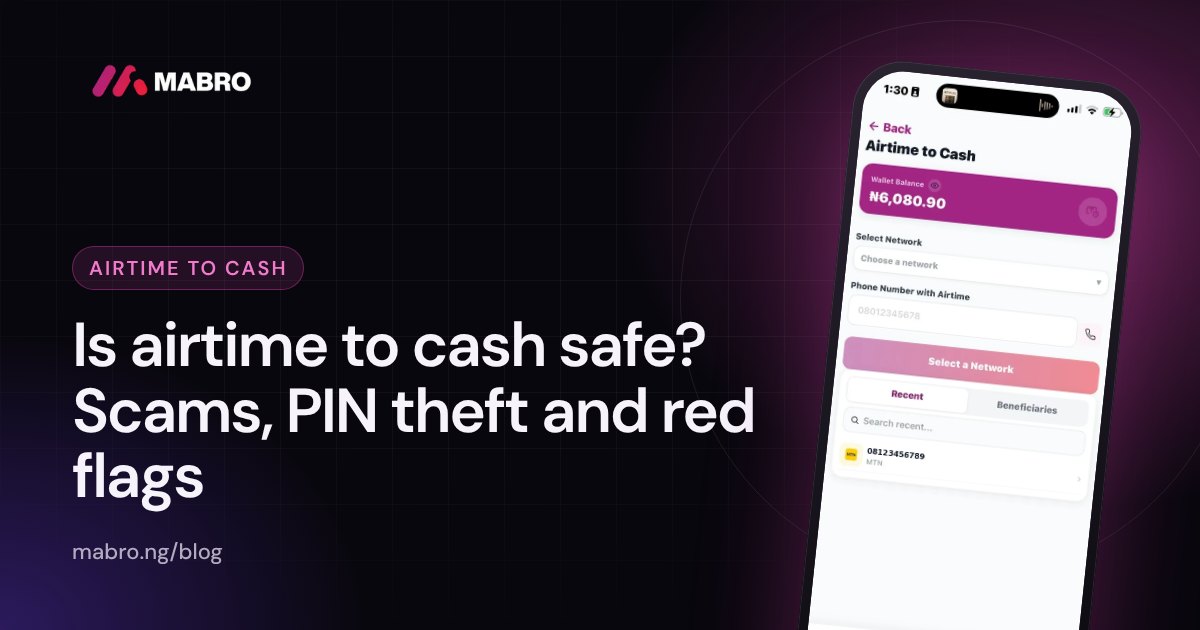
Airtime to cash is one of those services that works quietly until something goes wrong. You move airtime off your line, the receiving side confirms it, and naira lands in your wallet. When the person on the other side is honest, the whole thing takes minutes and nobody thinks about it again.
The question “is airtime to cash safe” has two halves, though, and they need separate answers. The first is whether the route is safe: does the airtime go only to a receiving line the service controls, and does the money come back to an account in your name? The second is whether the person you are dealing with is safe. A legitimate service cannot protect you from a stranger in your direct messages, and a stranger cannot give you the protections of a real platform. This guide separates the two, so you can tell which one you are looking at before you send anything.
What safe airtime to cash actually means
Every conversion carries three separate risks, and people usually blur them together:
- Counterparty risk. Whoever receives the airtime takes it and does not pay.
- Line security risk. Your transfer PIN, OTP or SIM is compromised, so airtime can leave your line without your knowledge.
- Platform risk. The service is unreliable, delays payouts, loses records, or is not what it claims to be.
A conversion is safe only when all three are handled. A friendly agent with a good rate solves none of them. A well-built app handles the first and third but still depends on you keeping the PIN to yourself for the second.
How a legitimate airtime to cash conversion works
Your airtime does not become cash inside the telecom network. It moves from your line to a receiving line operated for the service, using the carrier’s own transfer product and your own PIN. The platform sees the airtime arrive, prices it, and credits the naira to your wallet. From there you withdraw to your bank or spend it in the app.
The important part is the order of control. You start the transfer. You enter the PIN. The receiving number is displayed to you inside the app, under the service’s own name. The payout goes to the wallet tied to your verified account. At no point does another person need access to your line, your PIN or your phone.
This is also why the process fails in boring ways: a daily cap, a bonus balance that cannot be transferred, the wrong network selected, a PIN typed incorrectly. Boring is good. A process that fails predictably is a process with rules, and rules are what make a service verifiable.
The line that separates a service from a scam
If you remember one rule from this guide, make it this: nobody needs your transfer PIN except you.
The airtime transfer PIN is set on the SIM, and it authorises movement out of your line. A real platform never asks you to type it into a chat, a web form or a “verification” page. You enter it in the carrier’s own prompt, on your own phone, for a transfer you started. Anyone who asks for it — an agent, a “support officer”, a buyer, a page that claims to confirm your number — is asking for control of your line.
Almost every other scam follows from that one. Fake agents need your airtime or your PIN. Fake platforms need your number and PIN. SIM-swap fraud needs your identity and a way to intercept your OTP. Refuse to hand over the PIN and most of the attack surface disappears.
Scam one: the fake agent
The most common version lives in WhatsApp groups, Instagram comments and Telegram channels. Someone advertises a rate better than the apps, asks you to send airtime to a number, and promises payment “immediately after confirmation”. You send. They go quiet, or produce a story about a pending transfer, or ask for “one more transfer to unlock the first”. There is no escrow, no record and nobody to complain to.
The tell is not the rate on its own. It is the direction of trust. A real service asks you to send airtime to a number it displays in its own app, with a transaction record attached and a payout into your own account. An agent asks you to trust a phone number that exists only in a chat. If the number changes between conversations, that is not a busy business; it is a rotation.
Scam two: PIN harvesting
PIN harvesting is quieter than fake agents and more damaging. It usually starts with a plausible reason to need your PIN: “the transfer is blocked, send your PIN so I can release it”, “confirm your PIN to verify the line”, or a page that looks like your carrier’s menu and asks you to log in. Once someone has the PIN, they can move airtime from your line whenever they like, including long after you stop dealing with them.
The same information is often used to prepare a SIM swap or to reach accounts tied to the number. A transfer PIN is not a password you can rotate easily; it is a key to the line. Treat any request for it as an attempt to take something, not a step in a trade.
Scam three: fake alerts and screenshots
A bank alert image is not a payment. A screenshot of a transfer confirmation is not a payment. Both can be produced in seconds, and both are routinely used by buyers who want airtime “first” because their transfer is “processing”.
The only reliable check is your own available balance in your own banking app, after the money has actually settled. Even an incoming SMS alert is a notification, not a settlement. If someone is pushing you to send airtime because they have “already paid”, the answer is to wait — a genuine buyer loses nothing by waiting a few minutes.
Scam four: the overpayment reversal
This one borrows a trick from peer-to-peer trading. The “buyer” sends more than agreed, then asks you to refund the difference to a second account, then reverses or recalls the original transfer. You end up with the airtime gone, the refund gone, and a bank looking at a suspicious inflow.
If a payment is wrong, the fix is to reverse it through the same channel, not to send money to a new account someone gives you in a chat. A request to route the difference elsewhere is a red flag, not a courtesy.
Scam five: the cloned platform
Fake sites copy a real app’s look: the logo, the colours, a “sell airtime” form that collects your number and PIN, and a confirmation screen that never arrives. The address is usually slightly different, and the site is reached through a link in an ad or a message rather than a store listing.
Check three things before using any platform: where the app was installed from, the exact web address, and whether the flow shows a receiving number you can verify. A page that asks for your PIN in a text field is wrong no matter how good the design is. Your PIN belongs in the carrier’s prompt, never in a form.
Scam six: the recovery agent
After a loss, someone appears offering to recover your airtime or your money for an upfront fee. There is no recovery service. Airtime that left your line is gone, and the “agent” is running a second scam aimed at the same person. Block the contact, report it, and move on.
How SIM swap connects to all of this
A SIM swap is when your number is moved to a SIM you do not hold. It happens through impersonation at a retailer, a compromised insider, or a convincing story about a lost phone. Once the number moves, OTPs and bank alerts go to the attacker, and accounts tied to the number can be reset.
The connection to airtime is direct: whoever holds your SIM can receive the one-time codes that protect everything else, and a shared transfer PIN makes the line even easier to use. If your phone loses service for no reason and stays off for hours, treat it as a possible swap attempt. Call your carrier from another line immediately, and check your bank and wallet apps once service returns.
How to verify a platform before you sell
- Where did the app come from? An official store listing or the operator’s own site, not a link in a message.
- Does it display the receiving number before you transfer? It should, and that number should stay consistent with the service’s identity.
- Does it ever ask for your PIN in a field? It should not. The PIN belongs in the carrier’s prompt.
- Where does the payout go? To your own verified wallet or bank account, never to a third party.
- Is there a transaction record? A reference, an amount, a rate and a status you can revisit.
- Is support reachable before you need it? Try it with a small question first.
- Does the flow explain failures? A clear reason for a rejected transfer, not silence.
The safe order of operations
- Open the app yourself and sign in. Do not use a link someone sent.
- Choose the network and enter the number holding the airtime.
- Read the receiving number, the amount, the rate and the naira you will get before confirming.
- Confirm, then complete the airtime transfer using the carrier’s own prompt with your transfer PIN.
- Wait for the receiving side to confirm. Do not send a second transfer while the first is pending.
- Check your wallet for the credit, and open the transaction detail for the reference.
- Withdraw or spend from the wallet.
- Keep the receipt until you have no reason to need it.
The order matters because each step narrows what can go wrong. Reading the receiving number catches a fake flow. Waiting for confirmation catches a double send. Keeping the receipt catches the rare case where the credit and the confirmation disagree.
Red flags, and what they actually mean
| Signal | What it usually means |
|---|---|
| “Send your PIN so I can process it” | Someone wants your line, not your trade |
| A rate far above every app | The payout is delayed, reduced, or never made |
| The receiving number comes from a chat | No record, no platform, no recourse |
| “Send first, I’ll pay after confirmation” | Airtime is not reversible |
| A screenshot of a bank alert | A notification can be faked; your balance cannot |
| Urgency, countdowns, “last slot” | Pressure is replacing evidence |
| A link instead of an app listing | A cloned page collecting your details |
What the discount does and does not tell you
A2C rates sit in a narrow band because carrier fees and the risk of the trade are roughly fixed. A quote far above the market is not generosity; it is advertising paid for somewhere else — a longer wait, a hidden deduction, or a payout that never arrives.
But a normal rate is not proof of legitimacy either. Scammers quote normal numbers all the time, because a normal number is what a cautious person expects. The discount tells you what the trade costs. It does not tell you who is on the other side. That question is answered by the flow, the account the money goes to, and whether the PIN stays in your hands.
Protecting the line itself
- Set a SIM PIN if your carrier supports it, so a stolen phone does not expose the line.
- Never share your transfer PIN, OTP or SIM-swap code with anyone, including someone claiming to be support.
- Do transfers yourself, on your own device, in your own app.
- Watch for sudden loss of service, unexpected “welcome” messages, or calls asking you to confirm details.
- Check your airtime balance after every transfer; you should see the exact amount leave.
Why a pending transfer is not a lost transfer
Between the carrier accepting the transfer and the platform confirming it, the trade is waiting, and nothing is wrong yet. The danger is impatience: a second transfer while the first is pending can hit the daily cap, double the airtime moved, and make reconciliation harder.
Check the transaction detail before repeating anything. A pending record with a reference can be resolved; a repeat creates a second record to untangle.
If you have already been scammed
- Stop sending. Do not send “one more” to unlock the first.
- Contact your carrier. Report the transfer, ask what can be traced, and flag any suspected SIM issue.
- Report inside the platform if a platform account was involved, with the reference and the chat.
- Tell your bank if money moved through an account, and ask for guidance on the inflow.
- File a report with the police or the relevant authority, and keep the reference number.
- Keep the evidence: messages, numbers, screenshots, transfer records, dates.
- Do not pay a recovery agent. That is the next scam, not a solution.
What recovery realistically looks like
Airtime transferred to another line is generally not reversible. The carrier records the movement but cannot force the recipient to return it. What reporting does is create a trail — a pattern of numbers, accounts and messages that can support an investigation and warn other people. That is worth doing even when the airtime is gone.
If the loss went through a bank account, the bank may be able to act while the funds are traceable, so speed matters. Keep the transfer record and the chat instead of deleting them in frustration.
First conversions, family lines and shared phones
For a first conversion, use a small amount and a platform you have verified. Do the transfer yourself, even if someone offers to “help”. A shared phone or a borrowed SIM is the most common way a first-time user loses money, because the PIN and the OTP end up with the wrong person.
If you are converting on behalf of a family member, the line owner should enter the PIN. Using someone else’s line without their permission is fraud, and the transfer history identifies whose airtime moved.
When the airtime belongs to a business
Shops and agents hold large balances, and that changes the stakes. Keep the flow documented: one person authorised to sell, a record for every transfer, and a payout to a business account. Do not let staff share a transfer PIN; a shared PIN is a shared line, and a dishonest transfer is hard to trace once the PIN is common knowledge.
Comparing two legitimate platforms
Once both routes are real, compare the final naira for the same amount, the speed of the credit, the clarity of the failure messages, and the quality of the record. A slightly worse rate with a clear receipt beats a slightly better rate with a vague one, because the receipt is what you need when something goes wrong.
Compare how each handles a pending transfer, too. A platform that shows a state, a reference and a path to resolution has a process. One that asks you to wait “patiently” with no record does not.
Mistakes careful people still make
- Checking the rate twice and the receiving number once. The number is where the value goes; the rate is only what you are paid for it.
- Saving the PIN in a notes app. A PIN in a note is a PIN a thief already has.
- Using a friend’s phone “because my battery is low”. The session, the PIN and the OTP now belong to the friend’s device.
- Continuing after a small failure. One failed transfer is a signal to read the reason, not to send a bigger one.
- Deleting the chat after the payout. The chat is part of the record.
Frequently asked questions
Is airtime to cash legal in Nigeria?
Transferring airtime you own is a service carriers provide, and platforms that facilitate the conversion operate within that space. The illegal part is using someone else’s line or someone else’s money without permission.
Is it safe to sell airtime to an agent on WhatsApp?
It is the least protected route. There is no escrow, no record and no one to hold responsible if the agent does not pay. Use a platform that pays into your own account, or treat the agent as a personal risk you have chosen to take.
Can a platform steal my airtime?
A platform receives the airtime you send it, so the real question is whether the payout happens. That is why the receiving number, the rate and the payout route should all be visible before you transfer. A conversion you can read is a conversion you can verify.
Will anyone ever legitimately ask for my transfer PIN?
No. Your PIN is entered by you in the carrier’s prompt. Anyone else asking for it is asking for control of your line, whatever reason they give.
What is the safest amount for a first sale?
A small one. Test the route with an amount you could lose without hurting your month, and increase only after you have seen how the payout and the receipt work.
How fast should a legitimate conversion be?
The airtime leg is usually immediate once the carrier processes it, and the receiving side normally confirms within minutes. Bank withdrawal after that follows normal banking hours. A platform that promises instant bank settlement at a great rate deserves a second look.
Can I reverse airtime sent to the wrong number?
No. The carrier cannot force a recipient to return airtime. That is why the receiving number is shown before you confirm, and why you should read it every time.
Why do so many scams use airtime rather than bank transfers?
Because airtime is fast, widely available and hard to reverse. Once it is on another line, the value is effectively gone, which makes it attractive to anyone who wants to take something without a trace.
What are the signs of a SIM swap?
Sudden loss of service that lasts, unexpected welcome or activation messages, and a carrier call asking you to confirm personal details. Call your carrier from another line immediately if you see them.
Can I sell airtime from a line that is not mine?
Only with the owner’s permission and their PIN. Anything else is fraud, and the carrier’s records identify the line the airtime came from.
Is a bank alert enough proof that a buyer paid?
No. Alerts can be faked and transfers can be reversed. Check your own available balance, and give it time to settle before sending anything.
Should I keep the receipt after the payout lands?
Yes, for a while. The receipt is the record of the rate, the amount and the reference. It is the first thing support or a bank will ask for if a question comes up later.
What should I do if a platform refuses to pay after I sent airtime?
Save the transaction detail, the chat and the transfer record, and raise it with the platform in writing. If the platform is unresponsive, report it to your carrier and the relevant authority. Do not send more airtime to “unlock” the payout.
Ready to convert safely? Sell airtime for cash on Mabro, or read the full guide on how airtime to cash works, rates and risks. Your balance is always visible in the virtual wallet.