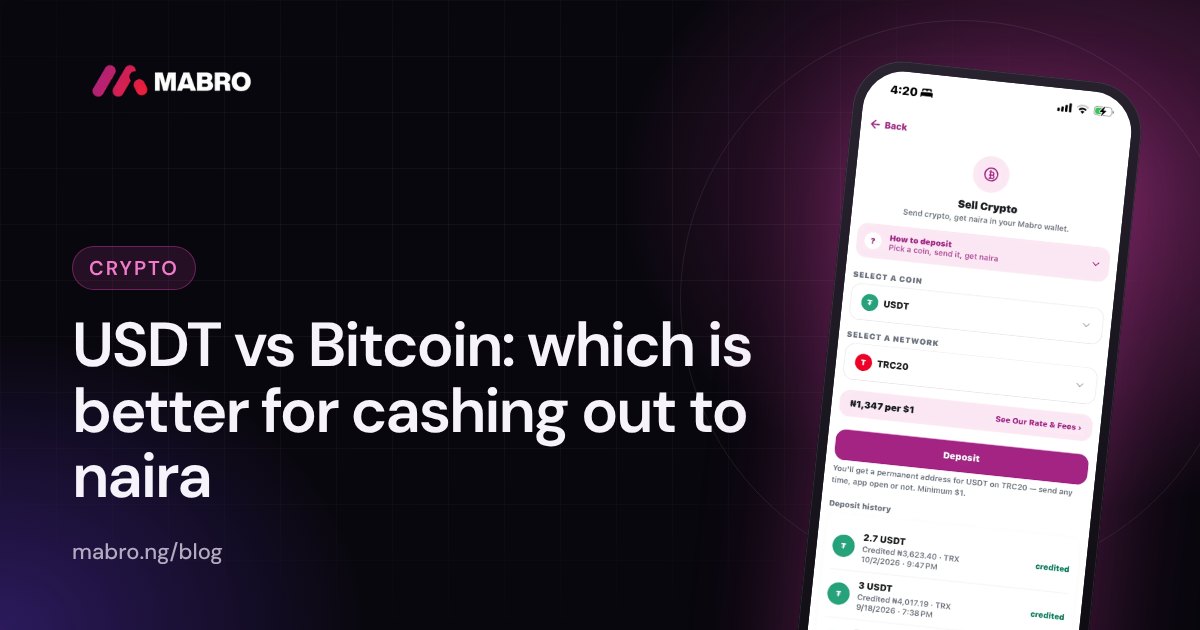
USDT and Bitcoin are the two coins most Nigerians hold when they intend to convert to naira, and they behave nothing alike. The USDT vs Bitcoin question is not about which coin is “better” — it is about what you need the money to do in the next few weeks.
This guide compares them honestly: stability against volatility, network fees and speed, which one suits a near-term naira need, which one makes sense to hold, and the conversion risks that catch people regardless of which coin they chose.
USDT vs Bitcoin: the core difference
USDT is a stablecoin. It is designed to stay close to one US dollar, so its price moves very little against the dollar. Bitcoin is not pegged to anything; its price is set by the market and can move sharply in both directions within days.
That single difference decides most of the practical questions. If you are holding value for a naira payment next week, you want the thing that will not fall sharply while you wait. If you are holding for a year and believe in the asset, the volatility is the point.
Neither coin is “safe” in an absolute sense. USDT carries issuer and counterparty risk; Bitcoin carries price risk. The better question is which risk you can afford to take for the amount of time you plan to hold.
What each coin is used for in Nigeria
In practice, USDT is used as a dollar substitute. People receive it for work, hold it between trades, and convert it when they need naira. It is also the coin most freelance payouts settle in, because the amount is easy to agree when the price does not move.
Bitcoin is used as an asset. Some people receive it as payment, some buy it to hold, and some move it between wallets as a store of value. Its price is the reason people talk about it, and the reason it is a poor courier for a payment due on Friday.
The confusion comes from treating the two uses as one. A coin can be a good investment and a bad way to hold rent money. Recognising which job you are asking it to do is most of the decision, and it costs nothing to be honest with yourself about the deadline.
Stability vs volatility, in naira terms
A naira cash-out is a two-step calculation. First, the coin’s dollar value. Second, the naira rate the platform applies. With USDT, the first step barely moves, so the naira you receive depends mostly on the conversion rate. With Bitcoin, both steps move, and they can move in opposite directions.
Imagine you need to pay a bill in two weeks. If you hold USDT, the amount is roughly predictable; you can plan around the conversion rate shown in the app. If you hold Bitcoin, a bad week can leave you with less naira than you planned, and you may be forced to sell at a low point to meet the deadline.
Volatility is not automatically bad. It is bad when it collides with a fixed obligation. Money you must spend on a specific date should not be exposed to a price that can change by double digits while you sleep.
Network fees and speed
USDT exists on several chains. TRC-20 on Tron is the common local choice: transfers are fast and the fee is usually small. ERC-20 on Ethereum is slower and more expensive when the network is busy. BEP-20 on BNB Chain is cheap but only works when both sides support it.
Bitcoin settles on its own chain, where fees depend on network demand at the moment you send. A quiet period can be cheap; a busy one can cost a noticeable fraction of a smaller transfer. Confirmation usually takes minutes, but the exact time depends on the fee you attach and the backlog.
Speed and cost are not the whole story, but they matter for small, frequent conversions. For a large one-off payout, the difference is usually noise. The app shows the current fee and the expected timing before you confirm, so compare the final naira, not the headline.
The liquidity question
Liquidity is how easily you can convert without moving the price. USDT is deeply liquid in Nigeria because so many people use it for exactly this purpose. Bitcoin is liquid too, but the naira market for it is thinner, and the rate you are offered can vary more between routes.
For a large conversion, check that the route can handle the amount at the quoted rate. A quote that only holds for a small trade is not a quote for a large one. The app shows the amount it can settle and the rate that applies; read both before you send a single coin.
Thin liquidity also shows up as a wider spread. A route that looks cheap on a small test can pay less on the full amount, which is why testing with a small sale and then sending the rest is only safe if the rate is re-quoted for the larger figure.
Which to hold for a near-term naira need
If the money is for rent, school fees, a bill or a supplier payment within weeks, USDT is the honest default. Its stability means the only variable you are managing is the naira conversion rate, which you can lock at confirmation. You are not adding price risk to a deadline that cannot move.
There is a cost to that certainty: USDT is not an investment. It does not appreciate, and holding it for years earns nothing. But for money with a job to do soon, certainty is the feature, not the flaw.
The same logic applies to the route. A verified sell USDT flow prices the conversion before you commit, so the naira figure is known rather than hoped for. That predictability is what a near-term need requires.
Which to hold long term
Bitcoin is the one people hold for years, and that is a different decision. It has a long track record, a fixed supply and a market that has survived several deep drawdowns. It also has no yield and no guarantee, and its price can stay below your entry point for a long time.
USDT is not a long-term holding in the investment sense. It is a parking place for dollars, useful between trades or before a payout. Holding it for a year is not investing; it is waiting, with a small counterparty risk attached.
If your goal is to preserve naira purchasing power for a purchase in a few months, USDT’s stability is more useful than Bitcoin’s upside. If your goal is growth over years and you can tolerate the drawdowns, Bitcoin’s volatility is the price of that possibility. Neither answer is universal, and no guide can decide your risk appetite for you.
The conversion route matters more than the coin
People spend hours comparing USDT and Bitcoin and minutes choosing where to sell. That is backwards. The route decides the rate, the fee, the speed and the counterparty risk — and those affect your naira more than the coin’s price on a normal day.
A P2P trade at a great headline rate can cost you weeks if the buyer’s naira turns out to be tainted. A verified platform payout at a slightly worse rate gives you a traceable payment and a record. For most people, the second is the better trade, regardless of whether the coin is USDT or Bitcoin.
For Bitcoin specifically, the sell Bitcoin flow and the general crypto-to-naira guide explain how the naira leg works. The coin changes the first leg; the second leg is a banking process either way.
Risk one: the counterparty
Every conversion has a counterparty, even when it is a platform. In a P2P trade, the counterparty is a stranger whose bank account you cannot see. In a platform conversion, it is a business with a record. The difference matters when a bank later asks where the naira came from.
Tainted money is the risk people underestimate. A buyer can pay you from an account that is not theirs, or from proceeds of fraud, and your account can be restricted weeks later. The coin you sold is gone; the naira you received is frozen. See why P2P trades get accounts frozen for the mechanism.
Bitcoin does not make this better or worse. A reckless counterparty is a reckless counterparty. The fix is the route, not the coin.
Risk two: the wrong network
USDT’s biggest practical danger is the network. Sending TRC-20 USDT to an ERC-20 address, or BEP-20 to a chain that does not support it, usually loses the coins outright. There is no reversal, no support ticket that fixes it, and no platform that can recover an on-chain transfer.
Bitcoin has fewer network variants in everyday use, but address types still matter, and sending to the wrong address is just as final. The common failure is not the technology; it is copying an address from a chat instead of the app, or selecting the wrong network in a hurry.
Before every transfer, check three things: the network label matches on both sides, the address was copied rather than typed, and the first and last characters match the source. This is a thirty-second habit that prevents the most expensive mistake in crypto.
Risk three: rate slippage while you wait
A conversion is not instant end to end. The crypto leg can be fast, but the naira leg depends on banking rails. While you wait, the rate the platform will pay can move, especially if you are comparing a quote taken before the deposit with the rate applied at payout.
USDT reduces one kind of slippage — the dollar value — but not the naira rate. Bitcoin adds both. A confirmed quote, locked before you send, is the protection in either case. If a route cannot tell you the naira figure before you commit, it is not a price; it is an estimate.
USDT vs Bitcoin at a glance
| Question | USDT | Bitcoin |
|---|---|---|
| Price stability | Pegged to the dollar, moves little | Market-priced, can move sharply |
| Typical network | TRC-20, ERC-20, BEP-20 | Bitcoin mainnet |
| Fee profile | Low on Tron, higher on Ethereum | Varies with network demand |
| Speed | Seconds to minutes on Tron | Minutes, depending on fee and backlog |
| Best for near-term naira | Yes | Risky if the date is fixed |
| Best for long-term holding | No, it is a dollar parking place | Yes, if you accept volatility |
| Main risk | Issuer and network mistakes | Price and network mistakes |
Converting USDT step by step
- Open the sell flow and choose the network your USDT is on.
- Enter the amount and read the naira figure shown, not just the percentage.
- Copy the deposit address from the app and check the network label twice.
- Send the USDT and save the transaction hash.
- Confirm the quote once the deposit is credited.
- Receive naira in your wallet, then withdraw or spend it.
The whole flow is short, and the detail that matters is the network. Everything else is arithmetic you can read on the screen.
Converting Bitcoin step by step
- Open the Bitcoin sell flow and check the minimum and the current rate.
- Enter the amount and read the naira payout before committing.
- Copy the deposit address and, if the app shows a memo or tag, include it exactly.
- Send from your wallet and save the transaction ID.
- Wait for the required confirmations; Bitcoin is slower than Tron by design.
- Receive naira in your wallet, then withdraw to your verified bank account.
Bitcoin’s confirmation step is the one people underestimate. A transfer that is broadcast is not yet confirmed, and a payout that is waiting on confirmations is not lost — it is pending.
Splitting your holdings
Most people do not need to choose one coin for everything. A practical pattern is to keep near-term naira needs in USDT and longer-term savings in Bitcoin, so each pot carries the risk it can afford. The split is a personal decision, and it should change as your obligations change.
Whatever the split, keep the records separate. A single wallet holding both coins makes it harder to answer a bank or a platform question about a specific conversion, and harder for you to see which part of your balance is doing what.
A second pattern is to keep a small USDT buffer for unexpected bills and leave the rest in the asset you are holding deliberately. The buffer costs you the upside you would have had, and it buys you the ability to pay without selling at a bad moment. For most people that trade is worth making, because the bad moment always arrives without warning.
Records and tax
Every conversion is a financial event. Keep the date, the coin, the amount, the network, the rate, the naira received and the reference. If a bank, a platform or an adviser asks later, that record answers the question in seconds.
Tax treatment of crypto gains in Nigeria is still developing. Keep records of your trades and speak to a qualified adviser about your own situation; no general guide can make that determination for you.
When Bitcoin makes sense for a naira payout
Bitcoin makes sense when the amount is not tied to a fixed deadline and you are comfortable with the price moving while the transfer settles. It also makes sense when the counterparty specifically wants Bitcoin, or when the USDT route on your preferred platform is unavailable.
It makes less sense when you are selling to meet a bill this week. In that case, the volatility is not an opportunity; it is a risk you did not choose. If you must sell Bitcoin for a deadline, sell earlier than you think you need to, so a bad day does not force a bad price.
When USDT is the honest default
For most naira conversions in Nigeria, USDT is the simpler instrument. It is easy to price, widely accepted, fast on Tron, and it does not add price risk to a payment that has to happen. That is not a claim that it is a better investment; it is a claim that it is a better courier.
The remaining risks are operational: wrong network, wrong address, bad counterparty. All three are managed with the same habits that protect any crypto transfer, and none of them requires you to predict the market.
What “better” actually means here
If “better” means more naira today, the answer depends on the rate and the fee at the moment you convert, not on the coin. If “better” means less risk of a shortfall, USDT wins for near-term needs. If “better” means long-term upside, Bitcoin is the asset people mean, with the volatility that comes with it.
The useful move is to stop asking the coins to do the same job. USDT is for money that needs to arrive; Bitcoin is for money that needs to grow. Mixing those jobs is how people end up selling Bitcoin at a bad moment to pay a bill they could have covered with a stablecoin.
Other balances you may be cashing out
Not every naira need starts with USDT or Bitcoin. Many people are converting a gift card, an airtime balance or a data bundle they will not use, and the same questions apply: what is the final naira, how fast, and who is paying?
A gift card converts at a percentage of face value, and the rate depends on brand, region and denomination — see why the same card pays differently. Airtime to cash converts a prepaid balance at a discount, with carrier limits on how much can move in a day. A data bundle is usually bought rather than sold, so if you are topping up instead, buy airtime or data at the price shown in the app and keep the receipt.
For all of them, the payout should land in a wallet in your name. That is the common thread: the coin or card is the first leg, and the verified payout is the second. The second leg is where a good conversion becomes a defensible one.
Frequently asked questions
Is USDT safer than Bitcoin for cashing out?
For a near-term naira payment, yes, because its value does not swing while you wait. It still carries issuer and operational risk, so the route matters as much as the coin.
Which has lower fees?
USDT on TRC-20 is usually cheaper and faster than Bitcoin on-chain. The exact fee depends on the network and the moment, and the app shows it before you confirm.
How long does each take?
USDT on Tron typically confirms in seconds to minutes. Bitcoin usually takes minutes but depends on the fee and network demand. The naira payout follows banking hours in both cases.
Can I convert Bitcoin to naira on Mabro?
Yes, through the Bitcoin sell flow. You send to the address shown, the app prices it, and the naira lands in your wallet.
Which should I hold if I need naira next month?
USDT. A fixed obligation should not depend on a price that can move sharply. Lock the conversion when the rate suits you rather than gambling on a better one later.
Is USDT always worth one dollar?
Close to it, by design, but not guaranteed. It can trade slightly above or below the peg, and it depends on the issuer’s reserves. Treat it as a dollar proxy, not a bank deposit.
What is the wrong-network risk?
Sending USDT on one chain to an address on another usually loses the coins permanently. Always match the network on both sides and copy the address from the app.
Why is the naira rate different from the dollar price?
The platform applies a naira conversion rate to the dollar value. That rate reflects local demand and liquidity, which is why the same dollar amount can pay different naira on different days.
Can I convert part of my Bitcoin?
Yes. You choose the amount, subject to the minimum shown in the app. Partial sales are normal and often sensible when the rate is moving.
Do I need a bank account?
To receive naira in your wallet, no. To withdraw from the wallet, yes — a verified bank account in your own name is required.
Which is better for long-term savings?
Bitcoin is the asset people typically hold for years, with the volatility that implies. USDT is a parking place, not a growth asset. Decide based on your time horizon and risk tolerance.
Can I hold both?
Yes, and many people do: USDT for near-term needs and Bitcoin for longer-term savings. Keep the records separate so each conversion is easy to explain.
Is Bitcoin accepted everywhere USDT is?
No. USDT is more widely accepted for everyday conversions in Nigeria. Bitcoin support depends on the platform and the counterparty.
What about fee volatility on Bitcoin?
Bitcoin fees rise when the network is busy, so a small transfer can cost relatively more at peak times. Check the fee shown before sending, and avoid moving small amounts when the network is congested.
Ready to convert? Sell USDT for naira or sell Bitcoin on Mabro, and read how a USDT sale reaches your bank.